

Introduction
There’s a version of personal training most people are familiar with — a trainer counts your reps, pushes you to lift heavier, and sends you home sweaty. And then there’s what happens when you combine exercise science with clinical knowledge.
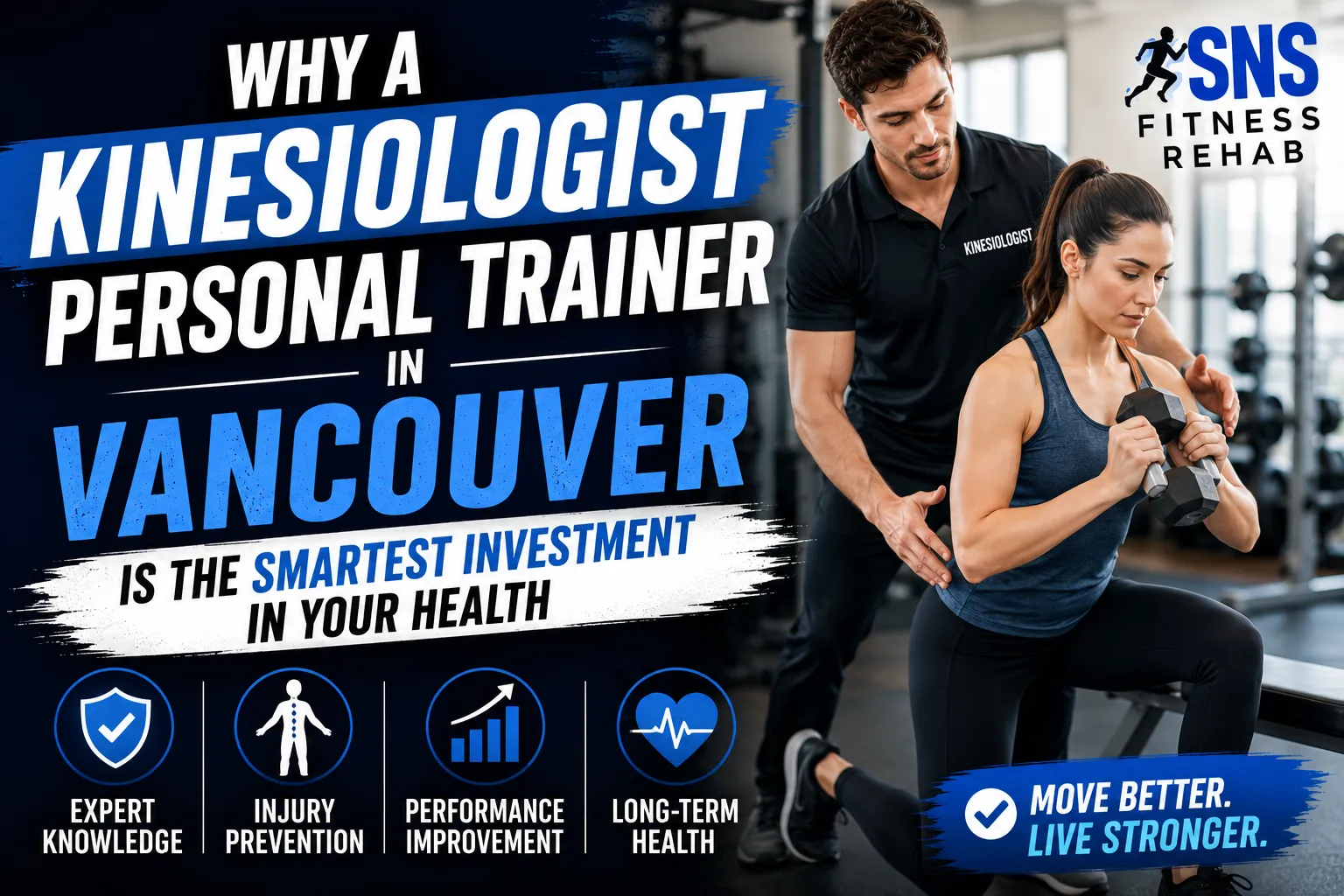
A kinesiologist personal trainer in Vancouver offers something fundamentally different: training that’s grounded in how your body actually moves, heals, and adapts. Whether you’re recovering from an injury, managing a chronic condition, or simply tired of fitness approaches that leave you sore and stuck, working with a kinesiologist changes the equation entirely.
Vancouver’s active lifestyle culture means locals want to move — and move well. But wanting to be fit and being able to train safely are two different things. That gap is exactly where kinesiology-based personal training becomes indispensable.
What Is a Kinesiologist, Exactly?
Before we get into why this matters for your fitness goals, it’s worth understanding what sets a kinesiologist apart from a general personal trainer.
A kinesiologist is a trained movement specialist with a university degree in the science of human movement — kinesiology. In British Columbia, kinesiologists are regulated through the British Columbia Association of Kinesiologists (BCAK), which sets educational and professional standards for practice.
In practical terms, a kinesiologist understands:
-
Biomechanics — how forces act on your joints and tissues during movement
-
Musculoskeletal anatomy — which muscles, tendons, and structures are involved in any given exercise
-
Exercise physiology — how the cardiovascular and metabolic systems respond to training loads
-
Pathology awareness — how injuries, surgeries, or conditions affect movement patterns
When that expertise is applied inside a personal training context, the result is programming that doesn’t just make you stronger — it makes you more resilient.
The Problem With Standard Personal Training After an Injury
Most people who’ve been through a physiotherapy program know the drill: you do your sessions, you improve, and eventually you’re discharged with a home exercise program. The problem? That program rarely bridges the gap between “recovered” and “performing well.”
General personal trainers, despite their best intentions, often aren’t equipped to:
-
Identify compensatory movement patterns that developed during injury
-
Modify exercises for specific joint or tissue vulnerabilities
-
Understand contraindications tied to surgeries or medical diagnoses
-
Progress load in a way that respects tissue healing timelines
This is where SNS Fitness Rehab’s personal training program fills a critical gap. By pairing kinesiology expertise with personalized training design, the approach treats fitness as a continuum — not a separate phase from rehabilitation.
What Maes Kinesiology-Based Personal Training Different
Movement Assessment Comes First
Every effective training relationship starts with understanding your baseline. A kinesiologist personal trainer doesn’t just ask about your goals — they assess how you move.
This typically involves:
-
Postural analysis
-
Functional movement screening
-
Joint mobility and stability tests
-
Strength asymmetry evaluation
-
Gait analysis where relevant
The assessment doesn’t just flag problems; it reveals the why behind chronic tightness, recurring discomfort, or performance plateaus. From there, your program is built around your specific movement profile — not a generic template.
Programming That Evolves With Your Body
Cookie-cutter programs fail because bodies aren’t cookie-cutter. A kinesiologist trainer designs programming that responds to how your body is actually adapting week to week — not just what the calendar says you should be doing.
This is especially important for:
-
Post-surgical clients who need progressive loading that respects healing tissue
-
Chronic pain sufferers who need desensitization alongside strength building
-
Older adults managing joint health, balance, and bone density simultaneously
-
Athletes returning from sport-specific injuries
The SNS Fitness Rehab team’s sport-specific training program takes this principle into the performance realm — applying the same clinical rigor to athletic development.
Education as Part of Every Session
One of the underrated benefits of working with a kinesiologist is that you actually learn what’s happening in your body. Rather than blindly following instructions, you develop body literacy — an understanding of why certain exercises are programmed, how to self-monitor fatigue, and when to push versus when to back off.
That knowledge compounds. Clients who understand their training make better decisions in the gym independently, stick with their programs longer, and suffer fewer setbacks.
Active Rehabilitation and the ICBC Connection
If you’ve been injured in a motor vehicle accident in British Columbia, you may already be navigating the ICBC (Insurance Corporation of British Columbia) active rehabilitation process.
Kinesiologists play a central role in ICBC active rehab programs. As part of an approved treatment team, a kinesiologist can assess your functional limitations, design a progressive exercise program, and help you restore the physical capacity you had before the accident — all while documenting your progress in a way that supports your ICBC claim.
SNS Fitness Rehab works with ICBC clients through their comprehensive rehabilitation services, helping people move from passive treatment toward active, sustainable recovery. If you’re looking for an ICBC kinesiologist in Vancouver, this kind of integrated approach can significantly shorten recovery timelines and improve long-term outcomes.
Common Conditions That Benefit From Kinesiologist-Led Training
The intersection of kinesiology and personal training is particularly powerful for the following:
|
Condition |
How Kinesiology-Based Training Helps |
|
Chronic low back pain |
Core stabilization, postural correction, load management |
|
Post-knee surgery (ACL, meniscus) |
Progressive strengthening, proprioception, return-to-sport prep |
|
Rotator cuff injuries |
Scapular stability, rotator cuff strengthening, overhead mechanics |
|
Osteoarthritis |
Joint-friendly exercise selection, inflammation management through movement |
|
Post-stroke rehabilitation |
Neuromotor re-education, balance training, functional independence |
|
Anxiety and depression |
Exercise-as-medicine protocols, mood regulation through structured movement |
This isn’t an exhaustive list. The common thread is that each condition requires clinical awareness, not just fitness enthusiasm.
What to Expect From Your First Session
If you’re new to working with a kinesiologist personal trainer, the first session might feel more like a clinical assessment than a workout — and that’s intentional.
Here’s a general overview of what to expect:
-
Health history intake — past injuries, surgeries, medical diagnoses, current medications
-
Goals discussion — short-term and long-term outcomes, lifestyle factors, previous training experience
-
Movement assessment — functional tests to identify strengths, limitations, and compensation patterns
-
Program design conversation — preliminary discussion of training approach, session structure, and progression plan
-
Initial movement practice — foundational exercises based on the assessment findings
Subsequent sessions build progressively from that foundation, with reassessments built in at regular intervals to track changes and update programming.
The Vancouver Context: Why Location Matters
Vancouver’s outdoor culture is both a gift and a challenge. Locals ski, cycle, run, hike, paddle, and play recreational sports year-round. That level of activity is wonderful — but it also means the injury burden here is real.
Working with a rehab personal trainer in Vancouver who understands the physical demands of this lifestyle means your training is built around what you actually want to do outside the gym. Whether that’s keeping up with your ski season, completing your first triathlon, or simply being able to hike the Grouse Grind without knee pain, the programming reflects those goals.
How to Choose the Right Kinesiologist Personal Trainer
Not all kinesiologist trainers are created equal. Here’s what to look for:
-
Registration with BCAK — ensures your trainer has the required educational background and adheres to professional standards
-
Experience with your specific condition — a trainer who has worked extensively with post-surgical clients, for example, understands the nuances that a general practitioner might miss
-
Communication style — your trainer should explain the why behind every exercise, not just demonstrate it
-
Collaborative approach — the best kinesiologist trainers communicate with your physiotherapist, physician, or other healthcare providers as needed
-
Client-centered programming — your plan should reflect your life, schedule, and realistic goals
FAQs
Q1: What is the difference between a kinesiologist and a personal trainer in Vancouver?
A kinesiologist holds a university degree in human movement science and is regulated by the BCAK in British Columbia. A personal trainer may have varying levels of certification. A kinesiologist personal trainer combines clinical movement expertise with fitness programming — making the approach more evidence-based and suitable for complex health situations.
Q2: Can a kinesiologist personal trainer help me after surgery?
Yes. In fact, post-surgical rehabilitation is one of the strongest use cases for kinesiology-based training. A kinesiologist understands tissue healing timelines, surgical precautions, and how to progressively load the body as it recovers — something a general trainer may not be equipped to manage safely.
Q3: Is working with a kinesiologist personal trainer covered by ICBC?
If you’ve been injured in a motor vehicle accident, ICBC active rehabilitation benefits may cover sessions with a kinesiologist. It’s best to confirm your specific coverage with your ICBC adjuster or healthcare provider.
Q4: How many sessions will I need before I see results?
Results vary depending on your goals and starting point. Many clients notice improved movement quality and reduced pain within the first 4–6 weeks. More significant strength and performance gains typically emerge over 3–6 months of consistent training.
Q5: Do I need a referral to work with a kinesiologist personal trainer?
In most cases, no referral is needed. You can contact SNS Fitness Rehab directly to book an initial assessment. However, if you’re accessing ICBC benefits, you’ll typically need to be active in an ICBC claim.
Q6: Can a kinesiologist personal trainer help me with chronic pain?
Absolutely. Exercise is one of the most well-supported interventions for chronic pain management. A kinesiologist trainer knows how to design programs that reduce pain sensitization while building functional capacity — a delicate balance that requires clinical awareness.
Q7: What should I wear or bring to my first session?
Wear comfortable athletic clothing and supportive footwear. Bring any relevant medical documentation — imaging reports, surgical notes, or a list of current medications — to help your trainer understand your health history.
Key Takeaways
-
A kinesiologist personal trainer combines clinical movement science with personalized fitness programming
-
This approach is ideal for post-injury recovery, chronic pain management, and performance optimization
-
Movement assessments are the foundation of effective, individualized training
-
Vancouver’s ICBC active rehab program integrates kinesiologists as key members of the recovery team
-
Choosing a BCAK-registered kinesiologist ensures professional accountability and clinical rigor
Conclusion
Fitness isn’t one-size-fits-all — and neither is recovery. A kinesiologist personal trainer in Vancouver brings something to the table that generic fitness coaching simply cannot: a clinical understanding of your body paired with the practical tools to help you move better, feel stronger, and stay active for life.
Whether you’re navigating the aftermath of an injury, managing a chronic condition, or simply ready to train smarter, this is an investment that pays dividends well beyond the gym.
Ready to train with purpose? Explore what SNS Fitness Rehab’s personal training team can do for your movement health today.
